

2025 end of year review...Don't call it a comeback

This year was measurably better than 2024, but it hasn't been easy. The return from burn out (combination of iron, energy, health and motivation issues) has not been straightforward.

2022 Data: 1,001 hours
Swim: 26 hours (72KM)
Bike: 368 hours (9,773KM + 150,000m+)
Run: 548 hours (5,350KM + 170,000m+)
Gym: 75 hours
2023 Data: 970 hours
Bike: 271 hours (6,800km + 117,000m+)
Run: 606 hours (5,356km + 217,500m+)
Gym: 91 hours
2024 Data: 898 hours
Bike: 250 hours (6,084km + 115,000m+)
Run: 581 hours (5,154km + 227,000m+)
Gym: 57 hours
2025 Data: 874 hours
Bike 257 hours (6,584km + 115,000m+)
Run: 553 hours (4,893Km +226,000m+)
Gym: 62 hours

Results
Ultra Trail Snowdonia 100M. 3rd. (ITRA index 762)
Verbier St Bernard 76km.3rd (ITRA index 824)
UTMB 100M. DNF
Templiers Endurance Trail 100km. 3rd (ITRA index 822)
Subida Conjuro 18km. 2nd. (Road race)
Overall, I'm much happier with my performances this year. I was able to race close to 100% of my ability at Verbier and Templiers. I had bad flu in March after the Kailas camp, followed by a sinus lift surgery, so I wasn't in the best shape for UTS in May. However, three third places at competitive races is at least consistent. If I had finished in the top 20 at UTMB, I would have considered it a comeback.
I was "cooked" for UTMB, after altitude training crashed my iron levels again...more on that below. I took a super conservative approach to the race, running 15 minutes slower to Les Contamines vs 2023. Despite this, before Courmayeur a lack of energy and diarrhea started to unravel my plan, crawling to Champex-Lac, and eventually stopping at Plan de L'au.
Last year I didn't know what was wrong with me so there was no regret in not finishing. This year I knew it was because of low Iron, so this DNF stung a lot more. I should have known better, and I ignored my coaches advice to not go to altitude. It still stings.
Iron
For detailed information on how iron deficiency was affecting me last year see 2024 review. I'm not a medical professional, this is just my experience and personal record.
After I started iron supplements last October, I thought I would be back to form in no time in 2025, but this was not the case. I started with about 60mg per day (elemental iron) which helped, but in hindsight, after 7 weeks on supplements I was not fully recovered for Chiang Mai 100M. I felt some arrythmia/heart thumping symptoms weeks after the race, and I also felt very run down for the winter and spring period. Blood tests showed that my ferritin hardly moved despite 4 months supplementation, which I suspect was due to racing in Chiang Mai. I switched to stronger supplements in March 2025.
IRON | 09/08/2019 | 17/07/2023 | 09/10/2024 | 31/10/2024 | 24/01/2025 | 28/05/2025 | 14/08/2025 | 18/12/2025 |
Ferritin (30-400 ng/mL) | 92 | 57 | 57.3 | 38.3 | 39.3 | 69.4 | 61.9 | 225.6 |
Transferrin Saturation (20-50%) | 38.35% | 33% | 16% | 54% | 32% | 46.51 | 12% | 57% |
Serum Iron (Range:12.5 - 34.5 μmol/L) (65-175 μg/dL) | 20.03 umol/L | 21,2 μmol/L | 55 μg/dL | 170 μg/dL | 99 μg/dL | 28.6 μmol/L | 7 μmol/L | 33.5 μmol/L |
TIBC (Range: 45 - 72 umol/L) (250-425 μg/dL) | 52.23 umol/L |
| 334 μg/dL | 315 μg/dL | 306 μg/dL | 61.5 umol/L | 56 μmol/L | 58.73 umol/L |
RBC |
|
|
|
|
|
|
|
|
Haematocrit (Range: 0.38 - 0.5 L/L / | 0.436 L/L | 42,7 % |
| 42,50 % | 44,90 % |
| 0.46 L/L |
|
MCV (Red blood cell size) (Range: 81 - 98) | 93.7 fl | 89 fL |
| 91,01 fL | 92,77 fL |
| 92.9 fL |
|
Haemoglobin (Range: 130 - 170) | 151 g/L | 147 g/L |
| 14,60 g/dL | 15,10 g/dL |
| 155 g/L |
|
Notes | UK | France | Spain | Spain | Spain | UK | France | UK |
| Vegan diet 6 months |
| Ferritin spike as 3 days post race? | Supplementation |
|
| Pre IV/post altitude camp | 4 months post IV. Still supplementing |
Bloods
Above are iron markers since 2019. These were taken in multiple countries, and therefore different units of measurement, and ranges are given.
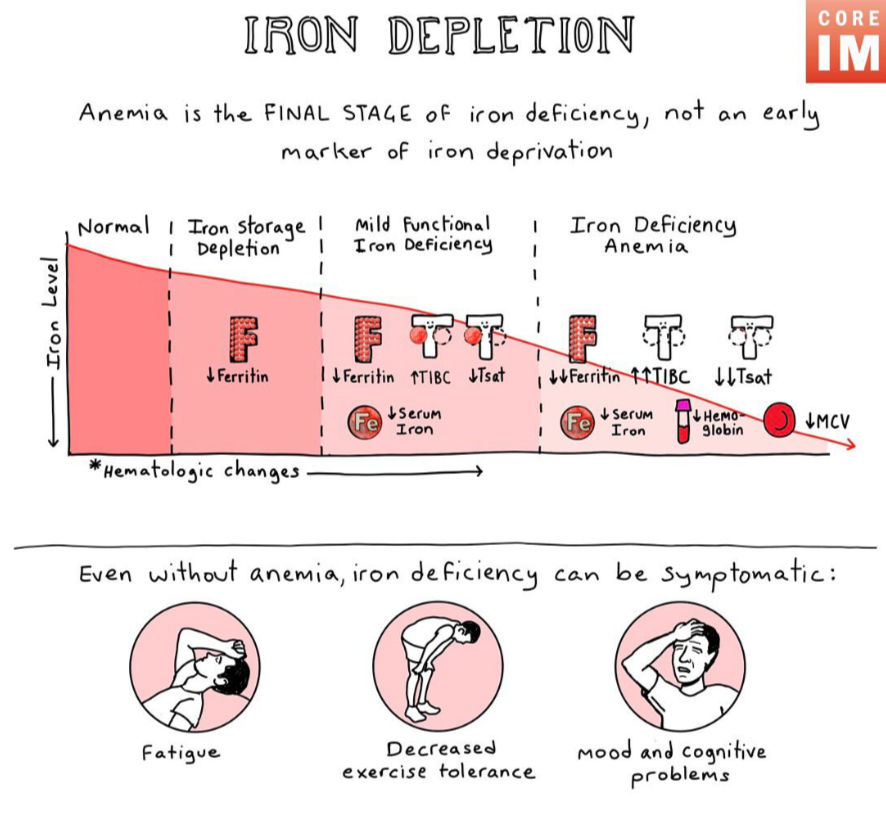
Getting regular blood tests for the last year has been hugely insightful into what is going on with my iron and red blood cells. The main issue I suffer from is that my serum iron and transferrin saturation (the protein that transports iron) figures drop well below the minimum range. This is "non anemic iron deficiency". The lowest these figures have been recorded was after altitude training in Tignes this year. In the space of about 3 weeks I went from training and sleeping well at altitude, to feeling fatigued, depressed and unable to train or recover from training.
What I take from this, is that altitude training works at producing more red blood cells, but the problem is that it crashes my iron saturation values. Without iron available in the blood, the additional hematocrit gives no benefit to performance. The chart below from "The Iron Clinic" on Instagram, gives a good overview of the sliding scale that is iron deficiency.
IRON IV
Once I had my blood results in France in August (showing my saturation levels were out of range), I had a consultation with a French doctor who wrote me a referral letter to receive an Iron IV in a French Hospital. The IV cost over 1,100 euros! However, since the IV was administered in a hospital (and was 100ml in size) it complied with WADA guidelines and no Therapeutic Use Exemption was required. Iron itself is not a performance enhancing substance.

Despite starting to feel better after the IV, I wasn't back to full health in time for UTMB just 10 days later. Thankfully 2 weeks after UTMB I did start to feel good again, really good. I felt like I was back to my "2022 self", with my resting heart rate dropping to as low as 37BPM... the lowest I've ever recorded it. In hindsight I wish I had gone with an IV a year ago when I might have had an opportunity with my low saturation levels. The problem was I would need to go to a clinic (which is not a hospital setting) and therefore would require a TUE, which I was reluctant about using. The advice from nutritionists I spoke to, was to go with supplementation first and if that didn't work then look at the IV option. It was a long and slow process to get my Ferritin up 30 points in the space of a year of supplementing. This seems to be the case with every athlete I've spoken to who has similar issues, supplementation is not a quick fix.
Tests for gluten intolerance suggested I'm not a coeliac. Given I had no issues in 2019 or before, I have to assume my body simply struggles with 900-1,000hrs per year of training and racing without supplementation. When I think about the worst symptoms, it does tend to correlate with periods of high volume training in the heat, altitude, and after 100M races, especially UTMB Chiang Mai 100M (where it's hot and my feet have got badly smashed up on both occasions racing there).
The last blood test showed Ferritin has rocketed to 225 after the IV, with my saturation and serum iron over the maximum range. I've stopped supplementing for now as it could start to be harmful with such high levels of iron in the blood. I'll continue low dose supplementation (14mg/day) once full training resumes, and continue to check my iron every 6 months for 2026.

Coaching and Training
This year was the first time I've been coached. I started working with Doug Stewart (TMR coaching) in December 24 but stopped in September 25. I was keen to work with Doug as he was coaching Keith Wigley and other friends at the Elite Trail Team (ETT). He had an understanding about Iron deficiency, and he was also offering his services for free with the potential of joining the ETT since I had applied in 2024 but hadn't got in.
I thought having a coach would be beneficial in getting back to health, and reduce the overall workload on myself by not having to worry about programming and decision making. The reality was that being coached is an active process for both the coach and the athlete. I hoped to have a greater say in the training, but that was not the case. We had disagreements on the training that I thought would be most beneficial to me, specifically around cycling.
I did a lot more running drills, strides, sprints, and double intensity days this year under TMR. I don't enjoy any of that training, and I feel like I get extremely tired with no noticeable benefits. I changed the programme to a lot more cycling in June and felt incredibly fit for Verbier.
There were certainly benefits in having someone to discuss training with, and the reassurance of someone to check in on me after years of largely solitary training. Not to mention that Doug crewed me twice at two 100M events this year. Despite this, having control of my own training is more beneficial.
My idea for training next year is to focus a lot more on cycling if possible. 10 days of bike touring at the end of this year was a great reminder of how strong you can get your legs and aerobic system. In theory by running less I might be able to reduce my iron needs from foot strike hemolysis (red blood cells get damaged in the feet due to the impact of running!).


I've also become a lot more aware of the total amount of stress my body is under due to the "extreme" temperatures in Sierra Nevada. It's uncomfortably hot in the summer, so sleep and training quality is severely impacted. The winters are relatively mild (but we still get frosts at 700m absl) but they feel much colder due to the house having a single log burner for heating, with thick walls and poor insulation.
For the last 4 years I've just suffered through the two extremes, or avoided it by travelling abroad. My plan going forward is to reinvest everything I can into the house that will improve training and recovery. This year I got the outside walls fixed and painted. Next year I will invest in air conditioning and a sauna.
2026 Season

After saying that I don't want to do too much, I'm looking at this 2026 calendar with a lot of trepidation. This race schedule was planned before changes had been made to the number of races in my contract. If at any point I feel like I'm not recovered or able to get fit or healthy for a race, then it will be a simple case of dropping it. The plan is to have two main peaks in fitness, one in the spring and one at the end of August. I'm doubtful about racing at Lavaredo, given the proximity to Snowdonia and UTMB. I think in all likelihood I will drop it and look at a later season race, most likely Ultra Trail Cape Town as a final World Trail Majors scoring race, and excellent opportunity to check out the trails there before the World Championships in 2027.
Index

My index continues to crumble. My performances tumbled in 2024 but are rallying in 2025.
Prize Money, Team, Sponsorships
There was good prize money at Templiers (1,000 euros for 3rd), not so much at Verbier (200 euros) and none at UTS which feels a little disappointing given the level of professionals now attending, and the size of that event. Fortunately the podium finishes all attracted a bonus from Kailas.
I started a contract with Styrkr as a nutrition sponsor this year. The products are great, and having a consistent fueling for training and racing is hugely beneficial.
I've just signed a new contract with Kailas for the next two years. It's been an amazing first year on the team. The speed at which they are producing new shoes, prototypes and innovative gear for trail and mountain sports is impressive. The team has had an amazing year and I think people are starting to recognize the brand as one of the bigger players now.
Key Takeaways from 2025
"You do you"...I know what training works best for me. Following the latest training methods or coaches programming wont necessarily be any better, and it might actually be worse if you don't believe in the training.
Stress from the cold and heat in Spain has a huge impact on training and sleep quality, as well as energy and health.
Listen to your body. In 2025 I really started listening, and responding to the cues. I'm paying close attention to HRV, resting HR (Objective) as well as sleep, mood and libido (Subjective).
Goals for 2026
To arrive at UTMB without Iron issues. The safest bet is no altitude training. If Iron levels are still good (Ferritin over 100, and high transferrin saturation) then I might do a short (16-18 day) block right before UTMB in Sierra Nevada.
No time or position goal for UTMB. I just want to be fit, healthy and go out and race it based on feel and not on splits.
Top 3 finish in the World Trail Majors series.
Increase my ITRA and UTMB Index.
Summary
I was surprised how long it took this year to find good sensations. Even with less training and racing it's still been a tough year with illness and surgery. Working with a coach for the first time was a worthwhile experiment. Perhaps I'm one of those athletes who struggles with being coached. I'm still open to the idea of working with someone if they are able to extract that next level of performance. I proved to myself in 2023 that I can compete at a good level. I haven't forgotten how hard it was to reach that level, but the objective for the next two years is to make the leap to the next level, from good to great!


Comments